Exploration on a bandit
A
tsallis_entmaxpolicy on the 10-armed testbed, where a learnableqanneals exploration into exploitation and achieves the lowest regret.
What it shows
The policy over arms maps a vector of preferences \(z\) to action probabilities
with tsallis_entmax, trained by the gradient-bandit / REINFORCE rule on the
Sutton & Barto 10-armed testbed (averaged over many independent runs). The map
has the closed form
where \(\tau\) is set so the probabilities sum to one and the entropic index q
controls how the policy explores.
At \(q = 1\) this is the classic softmax (Boltzmann) policy — every arm keeps a
non-zero probability, so the agent keeps paying to sample inferior arms. For
\(q > 1\) it becomes entmax / sparsemax, dropping clearly inferior arms to
exactly zero probability; but a fixed, very sparse policy (\(q = 2\)) commits too
early and can lock onto a sub-optimal arm, since zeroed arms receive no gradient
and cannot recover. Making q itself a policy parameter — updated by the same
REINFORCE gradient — lets the agent learn how sharp its exploration should be
rather than fixing it in advance.
How it works
The policy is one tsallis_entmax call; REINFORCE differentiates through it with
respect to both the preferences and q:
import jax, jax.numpy as jnp
import qjax

probs = qjax.tsallis_entmax(prefs, q=q, num_iters=30)
arm = jax.random.choice(key, K_ARMS, p=probs)

def log_prob(prefs, q_raw):
    qq = resolve_q(q_raw, q_fixed, is_learnable)     # q = q_min + span*sigmoid(.)
    pr = jnp.clip(qjax.tsallis_entmax(prefs, q=qq, num_iters=30), 1e-9, 1.0)
    return jnp.log(pr[arm])

# REINFORCE: ascend (reward - baseline) * grad log pi, jointly for prefs and q
g_prefs, g_qraw = jax.grad(log_prob, argnums=(0, 1))(prefs, q_raw)
Result
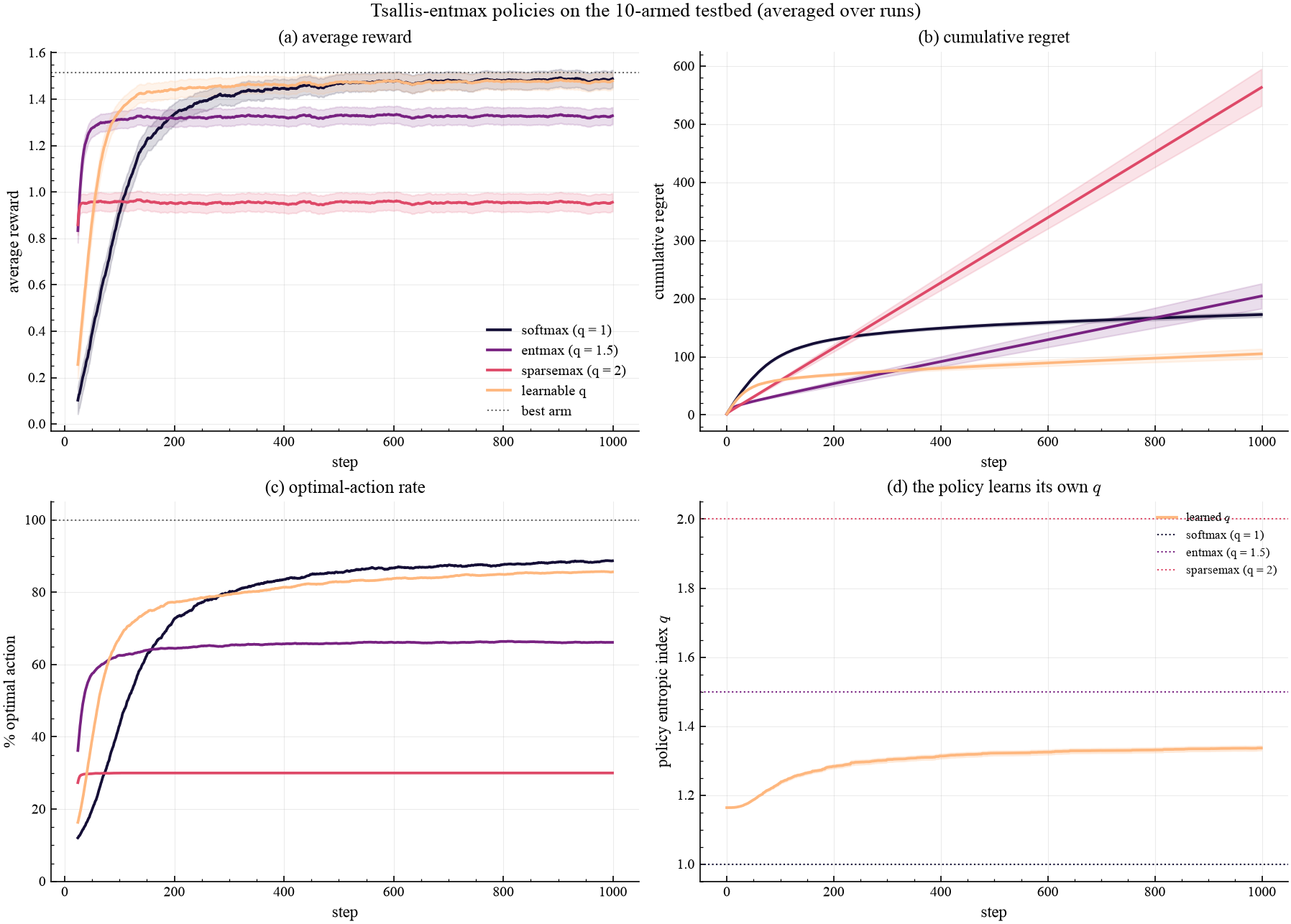
(a) Average reward, (b) cumulative regret, (c) %-optimal-action, and (d) the
policy’s learned q over training. The learnable policy starts near full
exploration and raises q as the best arm emerges, achieving the lowest
cumulative regret while matching softmax’s optimal-action rate.
Takeaways
tsallis_entmax() provides a one-parameter family of policies spanning
dense (softmax) to sparse (sparsemax) exploration. A fixed sparse policy commits
too early, whereas a learnable q anneals exploration into exploitation and
achieves the lowest cumulative regret. Because tsallis_entmax is differentiable
in q, this exploration schedule is learned by the same policy-gradient update,
not hand-designed.