Fitting q by maximum likelihood
Recover a hidden generating
qby gradient descent on theq-Gaussian log-likelihood — the simplest demonstration thatqis differentiable.
What it shows
We draw 20,000 samples from a q-Gaussian with a hidden \(q_\text{true} = 1.6\) and
\(\beta_\text{true} = 0.8\), then recover both parameters by maximum likelihood —
minimizing the negative log-likelihood
with plain gradient descent. Because the gradients \(\partial \mathcal{L} /
\partial q\) and \(\partial \mathcal{L} / \partial \beta\) are well-defined
everywhere (including at \(q = 1\)), the optimizer recovers the generating q —
concrete evidence that the entropic index is an ordinary learnable parameter, not
a fixed hyperparameter.
How it works
The only qjax call is q_gaussian_logpdf(). The parameters are
optimized in an unconstrained space and mapped into valid ranges (beta > 0,
q ∈ (1, 3)) so the gradients stay well-defined:
import jax, jax.numpy as jnp
import qjax

def neg_log_likelihood(params, x):
    beta = jax.nn.softplus(params["beta_raw"]) + 1e-3      # beta > 0
    q = 1.0 + 2.0 * jax.nn.sigmoid(params["q_raw"])        # q in (1, 3)
    return -jnp.mean(qjax.q_gaussian_logpdf(x, q, beta))

loss_and_grad = jax.jit(jax.value_and_grad(neg_log_likelihood))

params = {"q_raw": jnp.array(0.0), "beta_raw": jnp.array(0.0)}
for _ in range(400):
    loss, grads = loss_and_grad(params, data)
    params = {k: v - 0.05 * grads[k] for k, v in params.items()}
Result
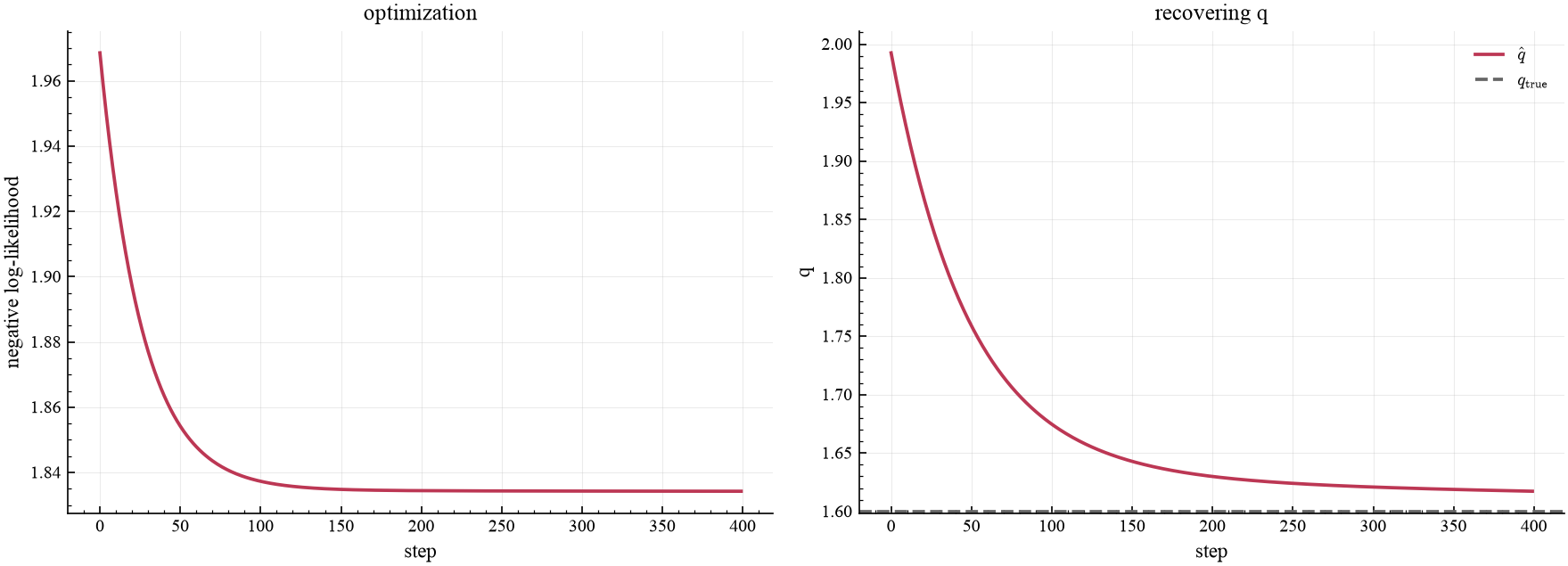
Left: the negative log-likelihood decreasing during optimization. Right: the
estimate q̂ converging to the true generating q = 1.6 (dashed line).
Takeaways
Since q_gaussian_logpdf() is differentiable in q, maximum-likelihood
estimation of the entropic index is just gradient descent — and the hidden q is
recovered accurately, validating q-as-a-parameter. The same idea scales to full
models in the classification,
reinforcement-learning and
attention examples, where q is learned jointly with the
network rather than fitted on its own.