Sparse self-attention
A single-head attention-pooling classifier with
tsallis_entmaxattention; a learnableqrecovers sparse, signal-focused attention as distractors grow.
What it shows
Each length-\(L\) sequence contains \(K\) informative tokens (carrying the class
prototype plus a shared “signal” direction) and \(L - K\) pure-noise distractors. A
single-head attention-pooling classifier must locate the informative tokens and
pool their evidence. The one knob is the entropic index q of the attention map,
which replaces the usual softmax with tsallis_entmax over the score axis:
At \(q = 1\) this is ordinary softmax attention (dense): every position —
including pure-noise distractors — receives a non-zero weight, so as \(L\) grows the
pooled representation is diluted by noise. For \(q > 1\) it becomes entmax /
sparsemax attention, assigning irrelevant positions exactly zero weight.
Making q learnable lets gradient descent discover the attention sparsity
that best fits the task.
How it works
The attention map is a drop-in replacement for softmax — tsallis_entmax over
the score axis:
import jax.numpy as jnp
import qjax

scores = keys @ params["query"] / jnp.sqrt(D_MODEL)        # (n, L)
attn = qjax.tsallis_entmax(scores, q=q, axis=-1, num_iters=25)
context = jnp.einsum("nl,nld->nd", attn, values)           # pooled representation
logits = context @ params["w_out"] + params["b_out"]
With q = 1 this is exactly softmax attention; with a learnable q the same
code trains the sparsity end-to-end.
Result
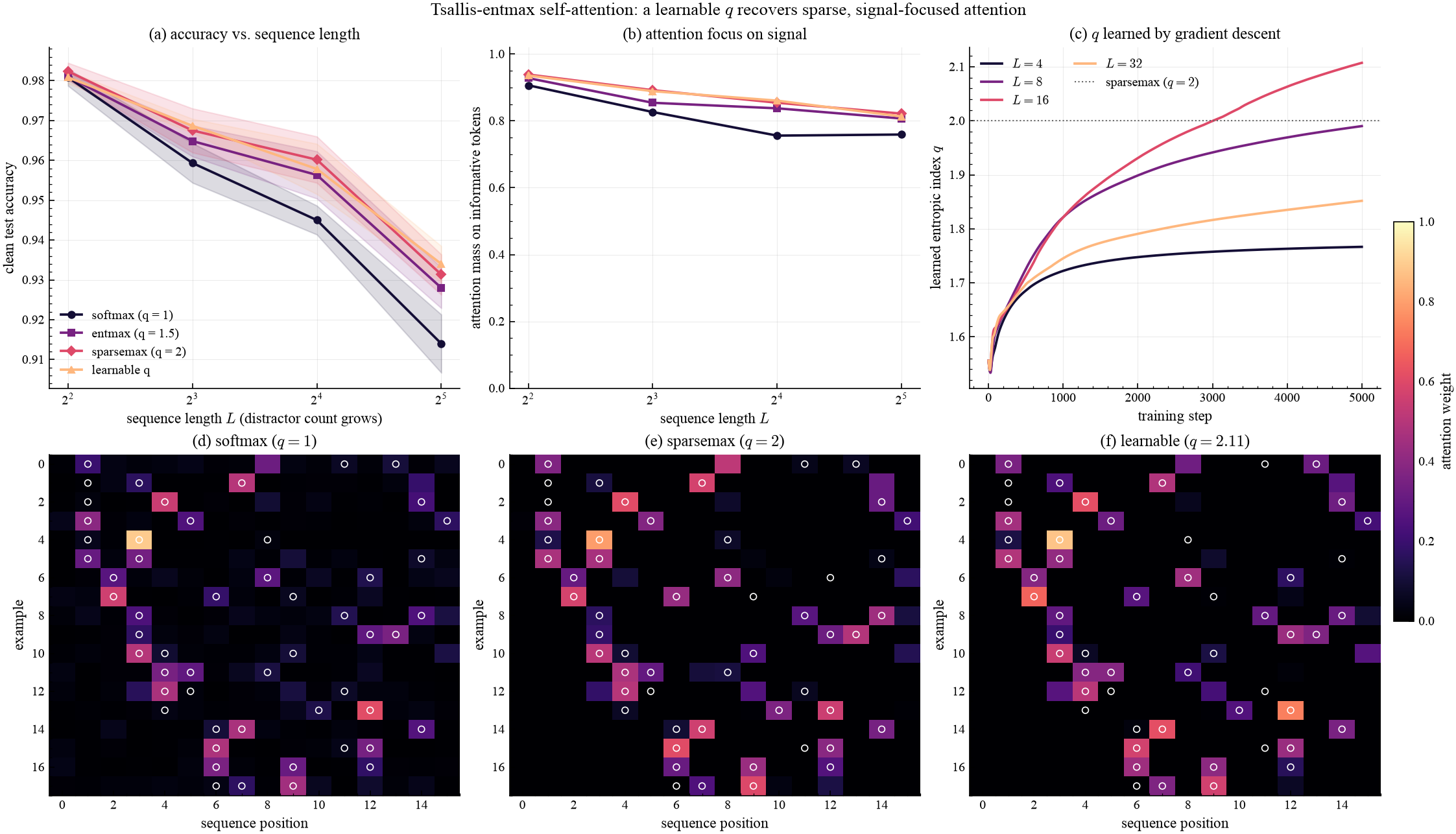
(a) Clean accuracy vs. sequence length (distractor count grows). (b) Fraction of
attention mass placed on informative tokens. (c) The learned q over training,
converging near sparsemax. (d–f) Attention maps (examples × positions) for
softmax, sparsemax, and the learnable q — white outlines mark the ground-truth
informative tokens; sparse attention zeroes out the noise.
Takeaways
tsallis_entmax() is a one-line, differentiable replacement for the
softmax in attention, with q controlling sparsity. Sparse attention (\(q > 1\))
ignores distractor tokens, so accuracy holds up as the sequences grow, and a
learnable q converges near sparsemax (\(q \approx 2\)) on its own — the same
learnable-q story as in classification and
reinforcement learning.