Learning q in attention
Watch the entropic index
qbeing learned inside an attention mechanism: asqrises toward sparsemax, the attention map sharpens onto the informative tokens.
This is the dynamic companion to sparse self-attention. The
same single-head attention-pooling classifier is trained, but here we animate the
optimization so the learning of q is visible frame by frame.
What it shows
A sequence has a few informative tokens (carrying a shared signal marker plus
the class) among many noise distractors. The attention map is
tsallis_entmax(scores, q), and q is a trained parameter:
def learned_q(params):
    # q is constrained to (1.1, 2.8) so it stays in the sparse-entmax regime
    return Q_MIN + Q_SPAN * jax.nn.sigmoid(params["q_raw"])

def forward(params, x, q):
    scores = (x @ params["w_key"]) @ params["query"] / jnp.sqrt(D_MODEL)
    attn = qjax.tsallis_entmax(scores, q=q, axis=-1)   # q flows gradients
    ...
q is updated by the same Adam step as every other weight — the entropic index
is just another differentiable parameter.
Result
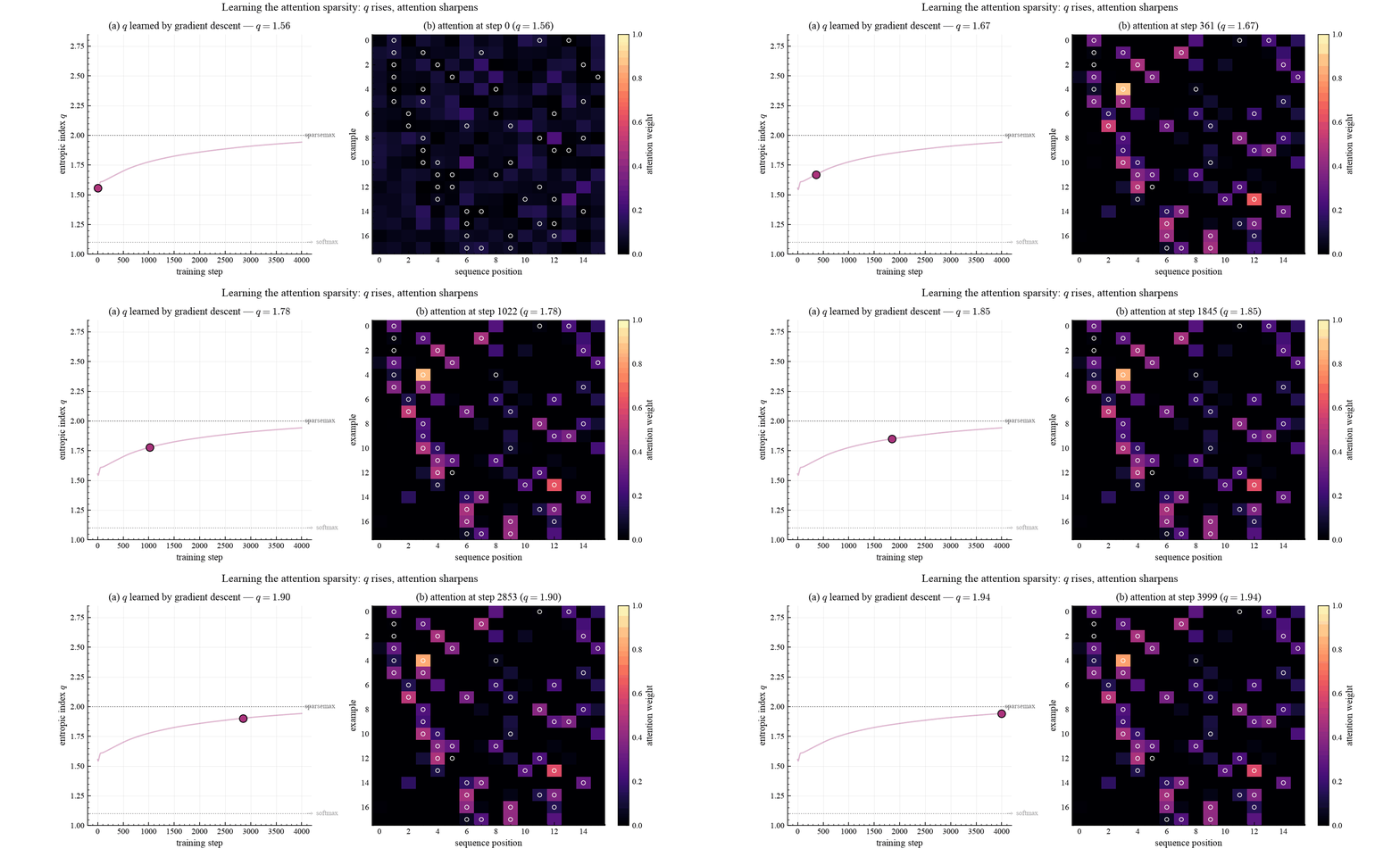
Left: the learned q over training, climbing from its initialization
(q ≈ 1.56) toward sparsemax (q = 2). Right: the attention map
(examples × positions) recomputed at each step — white outlines mark the
ground-truth informative tokens. Early on, attention is diffuse; as q is
learned the map sharpens and concentrates exactly on the outlined tokens, zeroing
out the noise.
Takeaways
qis learned end-to-end by gradient descent, not tuned — it converges near sparsemax (q ≈ 1.9) because that best solves the signal-in-distractors task.Attention sparsity and learning happen together: the rising
qand the sharpening attention map are two views of the same optimization.For the fixed-
qcomparison (softmax vs entmax vs sparsemax) across sequence lengths, see sparse self-attention.