Derivative-free optimization
A
q-exponential-weighted search whose heavy tails (q > 1) keep mass on far-from-best candidates and escape deceptive local minima.
What it shows
A cross-entropy-method (CEM) optimizer maintains a Gaussian search distribution,
draws a population of candidates, and refits the distribution to the lowest-cost
ones. Instead of a hard elite cut-off, each candidate \(x_i\) is softly weighted by
a q-exponential of its cost,
and the new mean and variance are the weighted moments of the sample.
At \(q = 1\) these are the ordinary Boltzmann weights \(e^{-c/T}\), which decay exponentially and concentrate greedily on the current best — so the search tends to collapse into whichever basin it starts near. For \(q > 1\) the weights acquire heavy, power-law tails that retain probability mass on far-from-best candidates, sustaining exploration. On a deceptive 2-D landscape — a broad global well plus a shallower decoy near the initialization — greedy \(q = 1\) (BGS) falls into the decoy, while heavy-tailed \(q = 2.5\) (Tsallis) keeps exploring and reaches the global optimum.
How it works
The q-deformed weighting is a one-line change to standard CEM:
import jax, jax.numpy as jnp
import qjax

samples = mu + sigma * jax.random.normal(key, (pop, 2))
costs = objective(samples)

# q-exponential weights (q = 1 -> Boltzmann; q > 1 -> heavy tails)
weights = qjax.q_exp(-(costs - costs.min()) / temperature, q)
weights = weights / jnp.sum(weights)

# refit the search distribution to the reweighted population
mu = jnp.sum(weights[:, None] * samples, axis=0)
sigma = jnp.sqrt(jnp.sum(weights[:, None] * (samples - mu) ** 2, axis=0)) + 1e-3
Result
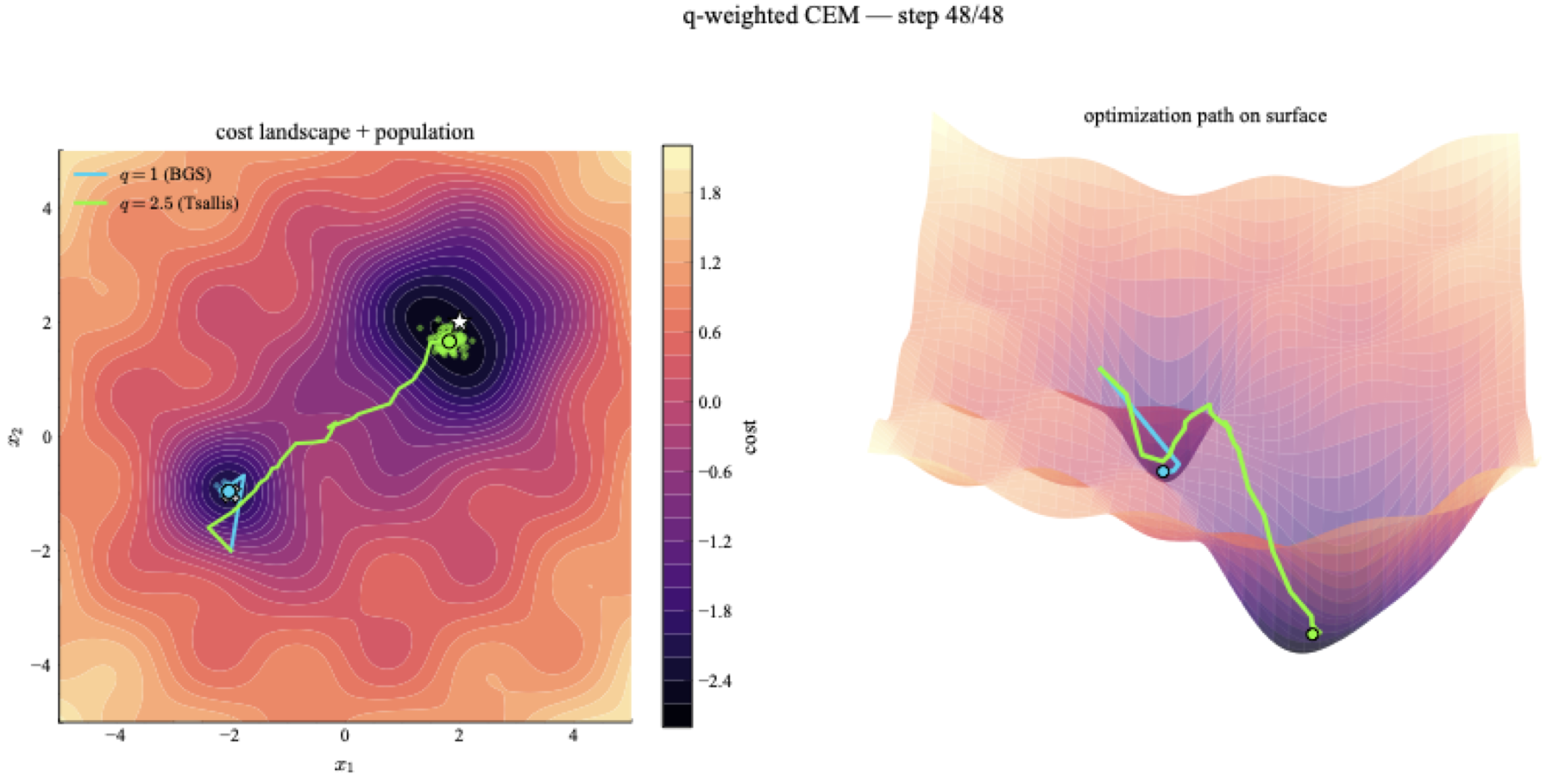
Left: the cost landscape with the live population and each method’s mean path (the
global minimum marked ★, the decoy ✗). Right: the same surface in 3-D with the
paths traced on it. Greedy q = 1 (BGS) settles in the decoy well, while
heavy-tailed q = 2.5 (Tsallis) escapes and reaches the global optimum.
Takeaways
Swapping exp for q_exp() turns the temperature into a tail-weight
knob: heavier tails (\(q > 1\)) trade a little greediness for robustness to
deceptive local minima, at no extra cost to the algorithm. The same
q-exponential is the building block of the q-Gaussian density
and of the q-deformed activations used elsewhere in the library.