Label-noise robustness
Bounded Tsallis cross-entropy (
q < 1) degrades gracefully under label noise, and a learnableqdiscovers the robust regime with no grid search.
What it shows
The same over-parameterized MLP is trained on a 4-class problem while a growing
fraction \(\eta\) of the training labels is corrupted at random. The only knob is
the entropic index q of the tsallis_cross_entropy() loss, which
replaces the logarithm of ordinary cross-entropy with the deformed q-logarithm,
At \(q = 1\) this is exactly the Shannon baseline: the per-example loss
\(-\log p_c\) is unbounded, so a confidently mislabeled example produces an enormous
gradient and the network memorizes the noise. For \(q < 1\) the loss is bounded
(the generalized cross-entropy of Zhang & Sabuncu, 2018) and its gradient
saturates on hard or mislabeled points, so clean-set accuracy degrades far more
gracefully. Making q learnable — training it jointly with the network —
goes one step further: minimizing the bounded loss favors smaller q (it
down-weights unfittable points), so q descends into the robust regime on its
own, with no grid search.
Every configuration is averaged over seeds and evaluated on a clean test set.
How it works
The loss is tsallis_cross_entropy on softmax probabilities; making q
learnable is just mapping a free parameter into the desired range:
import jax, jax.numpy as jnp
import qjax

def loss_fn(params, x, y_onehot):
    # learnable q in (0.3, 1.3): spans the robust (q<1) and Shannon (q=1) regimes
    q = 0.3 + 1.0 * jax.nn.sigmoid(params["q_raw"])
    p = jnp.clip(jax.nn.softmax(logits(params, x), axis=-1), 1e-7, 1.0)
    return jnp.mean(qjax.tsallis_cross_entropy(p, y_onehot, q=q, axis=-1))
Set a fixed q < 1 instead of the learnable one to get the bounded baselines.
Result
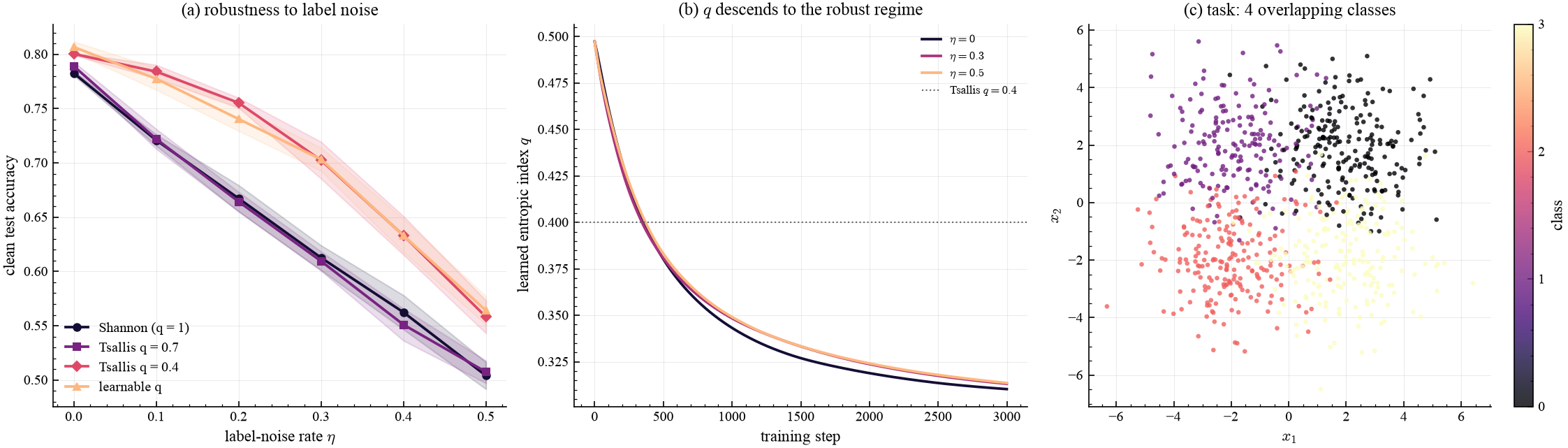
(a) Clean-test accuracy vs. label-noise rate η: bounded losses (q < 1) and
the learnable q stay far above the Shannon baseline as noise grows. (b) The
learnable q descends from its initialization into the robust regime during
training. (c) The synthetic task: four overlapping Gaussian classes.
Decision boundaries across shapes
A second figure (also produced by the script) makes the robustness visible. A
compact 3-class classifier is trained on two shapes — blobs and a spiral —
from clean data up to 40% label noise, comparing the Shannon baseline (q = 1)
with the bounded Tsallis loss (q = 0.3). The comparison is fair: within each
shape both losses share the same initialization, data, noisy labels and optimizer
— only q differs.
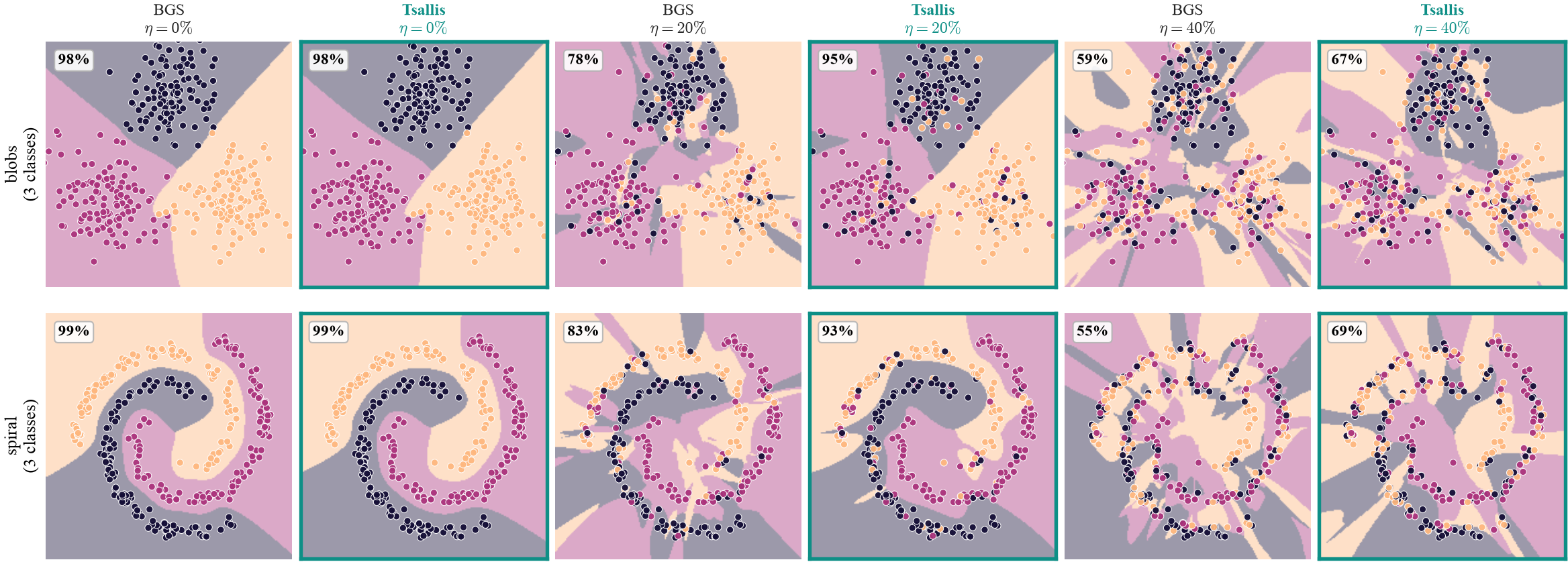
Decision regions at 0%, 20% and 40% label noise. The Tsallis (robust) columns are framed in teal. Without noise both losses match (≈98–99%); as noise grows the BGS baseline memorizes the mislabeled points and carves spurious wrong-class islands, while Tsallis keeps clean regions and higher clean-test accuracy.
At 0% noise the two losses are indistinguishable (blobs 98% vs 98%, spiral 99% vs 99%) — confirming the baseline is not handicapped. The gap opens only once noise is added: at 20% noise, 95% vs 78% (blobs) and 93% vs 83% (spiral); at 40%, 67% vs 59% and 69% vs 55%.
Takeaways
A single \(q < 1\) turns cross-entropy into a bounded, noise-robust loss, and a
learnable q discovers that robust regime automatically — matching or
slightly beating the best hand-tuned fixed q at every noise level. This mirrors
the other learnable-q results in
reinforcement learning and
attention: the right amount of non-extensivity is found by
gradient descent rather than by hand.